March 21, 2026· 14 min read
E-commerce Revenue Leak Calculator: Find the Money Your Store Is Losing Every Month
Calculate how much revenue your e-commerce store leaks each month from cart abandonment, slow pages, poor support, and missed upsells. Includes formulas and benchmarks.
Joseph Musembi · Founder, Raison Consult
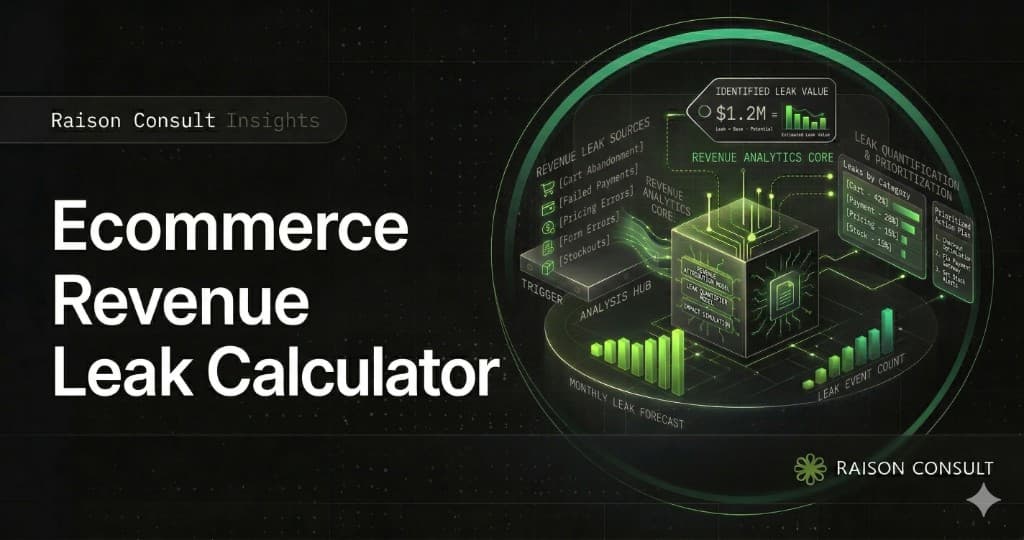
E-commerce revenue leak calculator: find the money your store is losing every month
Most store owners know their revenue number. They know their traffic, their conversion rate, maybe their average order value if they're paying attention. What they don't know is how much money leaves their business every month through gaps they've stopped noticing.
I'm not talking about marketing spend or inventory costs. I'm talking about the revenue that almost happened. The cart that was full but never checked out. The customer who had a question at 11pm, got no answer, and bought from a competitor. The returning buyer who was never shown a complementary product. The mobile shopper who bounced because your product page took four seconds to load.
These are revenue leaks. They're silent, they're compounding, and for most Shopify and DTC stores doing $500K to $10M in annual revenue, they add up to 30-50% of total potential sales.
Here's how to calculate exactly what they're costing you.
What is a revenue leak in e-commerce?
A revenue leak is revenue your store should be capturing but isn't, due to friction, gaps in your customer experience, or processes that haven't been optimized. It's different from a marketing problem. Marketing brings people to your store. Revenue leaks lose them after they arrive.
The distinction matters because most store owners try to fix revenue problems by spending more on ads. More traffic, more sales, right? But if your store converts at 2% and leaks revenue at every stage of the funnel, doubling your ad spend doubles the waste alongside the revenue. You're pouring water into a bucket with five holes.
According to the Baymard Institute, the average online shopping cart abandonment rate across 50 studies is 70.22%. That's 7 out of every 10 customers who put items in their cart and walk away. For a store doing $2M in annual revenue, that means roughly $4.7M in additional sales were sitting in carts that never converted.
Not all of that is recoverable. Some of those people were comparison shopping. Some weren't ready to buy. But even recovering 15-20% of abandoned carts, which is achievable with the right system, translates to hundreds of thousands in found revenue.
The five revenue leaks (and how to calculate each one)
Revenue doesn't leak from one place. It leaks from at least five, and they compound. Here's how to measure each one with your own store data.
Leak 1: Cart abandonment
This is the big one. It gets most of the attention for good reason.
Mastercard's Dynamic Yield platform, which tracks 200 million monthly users, puts the global cart abandonment rate at 76.8% as of 2025. Mobile is worse at 85.2%, compared to 66.7% on desktop. Industry rates range from 50% for grocery to 87% for travel.
Your calculation:
Monthly visitors x Conversion rate = Current orders
Monthly visitors x Cart-add rate = Carts created
Carts created - Current orders = Abandoned carts
Abandoned carts x Average order value = Revenue left in carts
Revenue left in carts x Recovery rate (15-20%) = Recoverable revenue
Example with real numbers:
A Shopify store with 100,000 monthly visitors, 2.3% conversion rate, and $150 AOV:
| Metric | Value |
|---|---|
| Monthly visitors | 100,000 |
| Cart-add rate (industry avg) | 8-10% |
| Carts created | ~9,000 |
| Orders completed (2.3% conversion) | 2,300 |
| Abandoned carts | ~6,700 |
| Revenue in abandoned carts | $1,005,000 |
| Recoverable at 15% | $150,750/month |
That's $150,000+ per month in revenue that was in the pipeline and didn't convert. Even at a conservative 10% recovery rate, you're looking at $100,000/month.
The most common reasons customers abandon, according to Baymard's checkout usability research: unexpected shipping costs (48%), forced account creation (26%), complicated checkout (22%), and concerns about payment security (18%).
Leak 2: Slow site speed
Page speed is one of those things everyone agrees matters and almost nobody measures properly.
Here's what the data says. Google's research found that 53% of mobile users abandon sites that take more than 3 seconds to load. Amazon's internal testing famously showed they lose approximately 1% in revenue for every 100ms of additional latency.
For mid-market e-commerce stores, the math is simpler but just as painful.
Your calculation:
Current load time (seconds)
Target load time (2 seconds or under)
Estimated conversion lift per second improved: 7%
Current monthly revenue x 7% per second = Revenue recovered per second shaved
RoastWeb's 2025 mobile CRO analysis documented a furniture e-commerce site that went from 5.4-second load times to 2.1 seconds. The result: conversion rates jumped from 1.2% to 2.3%, and monthly revenue increased by $1.7M (an 81% lift).
Example:
| Metric | Value |
|---|---|
| Current monthly revenue | $200,000 |
| Current load time | 4.2 seconds |
| Target load time | 2.0 seconds |
| Seconds to shave | 2.2 |
| Est. conversion lift (7% per second) | ~15.4% |
| Monthly revenue recovered | ~$30,800 |
Most stores running on Shopify with multiple apps, unoptimized images, and third-party scripts are in the 3-5 second range on mobile. Every second over 2 is costing you.
Leak 3: Customer support that costs instead of earns
Here's a number that surprised me when I first saw it: e-commerce support costs $2.70-$5.60 per ticket on average, according to Lorikeet's 2025 benchmarks. That sounds cheap until you factor in that the average customer contacts support 2.3 times per issue, making the real cost per issue $6.20-$12.90.
But the bigger leak isn't the cost of answering questions. It's the cost of not answering them.
Customers who reach out to support before buying and get a timely response convert at far higher rates than those who don't get help. When your support team is offline (nights, weekends, holidays), every unanswered pre-sales question is a potential sale walking out the door.
Qualimero's 2025 research found that companies with excellent customer service achieve 4-8% higher annual revenue growth than competitors, and customers willingly pay a 16% premium for good service.
Your calculation:
Monthly support tickets
Tickets outside business hours (typically 30-40%)
Average order value
Conversion rate of support-assisted sales vs unassisted
Revenue lost = After-hours tickets x AOV x missed conversion rate
Example:
| Metric | Value |
|---|---|
| Monthly support tickets | 2,000 |
| Pre-sales questions | ~600 (30%) |
| After-hours pre-sales questions | ~200 (33% of pre-sales) |
| Conversion rate of support-assisted sales | 15-25% |
| AOV | $150 |
| Revenue lost (200 x 20% x $150) | $6,000/month |
| Support cost (2,000 tickets x $5 avg) | $10,000/month |
| Total leak (lost revenue + support cost) | $16,000/month |
This one is smaller in absolute dollars for most stores, but it's the easiest to fix and has the fastest ROI. AI support tools can handle 60-80% of routine tickets and answer pre-sales questions 24/7. Alhena's ROI analysis shows AI support returns $3.50 for every $1 invested, with top performers seeing $8 per dollar.
Leak 4: Missing upsells and cross-sells
This leak is less obvious because you're not losing existing revenue. You're failing to capture additional revenue from buyers who already trust you enough to purchase.
According to WiserReview's 2026 data, product recommendations drive up to 35% of total e-commerce revenue. Cross-selling alone generates 10-30% of total revenue for stores that do it well. And selling to existing customers is 5-25x more profitable than acquiring new ones.
The specific numbers that matter:
- Order bumps (one-click add-ons at checkout) convert at 37-38%
- Post-purchase upsells convert at 15-30%
- Email upsell campaigns convert at roughly 9%
AfterSell's 2025 benchmark report found that adding just two upsell offers generates an average of $93,000 in additional annual revenue per brand.
Your calculation:
Monthly orders
Current upsell/cross-sell rate
Potential upsell rate (15-30% of orders)
Average upsell value (typically 20-35% of AOV)
Gap = (Potential rate - Current rate) x Orders x Upsell value
Example:
| Metric | Value |
|---|---|
| Monthly orders | 2,300 |
| Current upsell take rate | 5% (115 orders) |
| Potential upsell take rate | 20% (460 orders) |
| Average upsell value ($150 AOV x 25%) | $37.50 |
| Current upsell revenue | $4,312/month |
| Potential upsell revenue | $17,250/month |
| Monthly leak | $12,938 |
If you're not showing product recommendations on product pages, not offering order bumps at checkout, and not sending post-purchase upsell emails, you're leaving this money behind.
Leak 5: Returns that could have been prevented
Returns are the leak nobody wants to talk about because they feel inevitable. They're not, at least not entirely.
The National Retail Federation reports that e-commerce returns averaged 19.3% in 2025, more than double the 8.9% rate for physical stores. For U.S. retailers overall, returns totaled $849.9 billion in 2025, representing 15.8% of total sales.
But here's what's interesting: leading retailers with better product information, sizing tools, and AI-assisted shopping maintain return rates 34% below the industry average, according to Rocket Returns' 2025 analysis. That's a gap you can close.
Your calculation:
Monthly revenue x Return rate = Returned revenue
Processing cost per return (typically $10-$30)
Total return cost = Returned revenue + (Returns x Processing cost)
Preventable returns (30-40% of total) x Recovery rate = Saveable revenue
Example:
| Metric | Value |
|---|---|
| Monthly revenue | $345,000 |
| Return rate | 19% |
| Returns (dollar value) | $65,550 |
| Number of returns (at $150 AOV) | ~437 |
| Processing cost ($20 x 437) | $8,740 |
| Total return cost | $74,290/month |
| Preventable returns (35%) | $26,001 |
The fixes here are better product descriptions, accurate sizing guides, customer reviews with photos, and AI-powered fit recommendations. Not the most exciting work, but the math is clear.
How to calculate your total revenue leak
Here's the full calculation, using the example numbers from a store doing roughly $345,000/month ($4.1M annual) with 100,000 monthly visitors, 2.3% conversion rate, and $150 AOV:
| Revenue leak | Monthly amount | % of revenue |
|---|---|---|
| Cart abandonment (recoverable) | $100,500 - $150,750 | 29-44% |
| Slow site speed | $24,000 - $30,800 | 7-9% |
| Support gaps | $12,000 - $16,000 | 3.5-4.6% |
| Missing upsells | $10,000 - $12,938 | 2.9-3.7% |
| Preventable returns | $20,000 - $26,001 | 5.8-7.5% |
| Total monthly leak | $166,500 - $236,489 | 48-69% |
For this $4.1M/year store, the total addressable revenue leak is $2M-$2.8M annually.
That range is wide on purpose. Not every dollar in the leak is practically recoverable. Some cart abandonment is browsing behavior, not buying intent. Some returns are genuinely warranted. Some upsells would feel pushy and hurt the customer experience.
A realistic recovery target is 25-40% of the total leak, which puts you at $500K-$950K in additional annual revenue. For a $4M store, that's the difference between flat growth and 20%+ year-over-year improvement.
How AI changes the math
I built these calculations manually, but the interesting part is that AI is changing what's actually recoverable.
Traditional cart recovery relies on email sequences. Send an email 1 hour after abandonment, another at 24 hours, a final one at 72 hours with a discount code. These email flows recover about 3-5% of abandoned carts, according to Sendtric's 2026 benchmarks.
AI recovery systems work differently. They use 50+ behavioral signals to predict abandonment before it happens, intervene in real time with personalized offers, and follow up across email, SMS, and even voice. AgentiveAIQ's ROI analysis shows AI recovery rates of 45-56%, compared to 15% for email-only approaches. That's a 3x improvement.
The same pattern applies to support. Traditional support means humans answering tickets during business hours. AI support means answering pre-sales questions at 11pm on a Saturday, deflecting routine tickets automatically, and routing complex issues to humans who can actually help. AgentiveAIQ's deflection data shows AI handling 80% of tickets, cutting costs by 23.5% per contact.
And for upsells, AI product recommendation engines outperform static "customers also bought" widgets because they personalize based on individual browsing behavior, purchase history, and real-time intent signals.
| Leak | Traditional recovery | AI-powered recovery |
|---|---|---|
| Cart abandonment | 3-5% (email sequences) | 15-20% (multi-channel AI) |
| Support gap | Limited to business hours | 24/7 automated response |
| Upsell take rate | 5-8% (static widgets) | 15-30% (personalized AI) |
| Returns prevention | Manual sizing guides | AI fit prediction, visual search |
This isn't speculative. The 12.3% AI-powered cart recovery conversion rate we reference in our AI consulting pricing guide comes from deployed systems in production, not lab tests. Traditional passive email flows convert at 3.1%.
Do the math for your store
You need three numbers: your monthly visitors, your conversion rate, and your average order value. If you don't know your conversion rate, use 2.3% (the 2026 industry average from Buy Trifecta). If you don't know your AOV, use $153 (the U.S. e-commerce average).
Step 1: Calculate your cart abandonment leak
Take your monthly visitors. Multiply by your cart-add rate (use 9% if you don't know). That's your monthly carts. Subtract your actual orders. Multiply the gap by your AOV. That's the revenue sitting in abandoned carts. Multiply by 15% for a conservative recovery estimate.
Step 2: Check your site speed
Run your site through Google PageSpeed Insights. If your mobile load time is over 3 seconds, estimate 7% lost conversion rate per extra second. Multiply that conversion loss by your monthly revenue.
Step 3: Count your after-hours support gaps
Look at your helpdesk data. What percentage of tickets come in outside business hours? What percentage are pre-sales questions? Each unanswered pre-sales question during buying hours is a potential lost sale.
Step 4: Audit your upsell offers
Check your product pages, cart page, and post-purchase flow. If you don't have product recommendations, order bumps, or post-purchase offers, you're leaving 10-30% of potential order value behind.
Step 5: Analyze your return rate
Compare your return rate to industry benchmarks. If you're above average, the gap between your rate and the benchmark represents preventable returns.
Add up all five and you've got your total revenue leak. Most stores find it's between 30% and 50% of current revenue.
What to fix first
Not all leaks are equally fixable. Here's the priority order based on effort vs. impact:
| Priority | Leak | Why fix first | Typical ROI timeline |
|---|---|---|---|
| 1 | Cart abandonment | Highest dollar value, proven AI solutions | 2-4 weeks to deploy, ROI in month 1 |
| 2 | Support gaps | Fastest to implement, 24/7 coverage | 1-2 weeks to deploy, ROI in month 1 |
| 3 | Missing upsells | Low effort, compounds with every order | 1-2 weeks for basic, ongoing optimization |
| 4 | Site speed | Technical work required, big payoff | 2-8 weeks depending on complexity |
| 5 | Return prevention | Longer-term, requires content/data work | 1-3 months for measurable impact |
The first two are where AI makes the biggest immediate difference, and where we focus with our e-commerce clients. A Shopify store can have AI cart recovery and AI support running within two to four weeks. The revenue impact shows up in the first month's data.
I wrote a more detailed comparison of AI cart recovery vs traditional email flows if you want to dig into the specific performance data.
Frequently asked questions
How much revenue does cart abandonment cost e-commerce stores?
Cart abandonment costs U.S. e-commerce stores approximately $18 billion annually, according to industry data compiled by Upsella. Globally, recoverable revenue from abandoned carts in the US and EU totals an estimated $260 billion. For an individual store doing $4M in annual revenue, the recoverable portion typically ranges from $600K to $1.2M per year.
What is a good cart abandonment recovery rate?
The industry benchmark for email-based cart recovery is 3-5% of abandoned carts. AI-powered multi-channel recovery systems achieve 15-20% recovery rates, with top performers reaching 45-56% according to AgentiveAIQ's analysis. A store with basic email recovery should target 10-15% as a first milestone. With AI tools, 20%+ is realistic within 60 days.
How do I calculate my e-commerce revenue leak?
Multiply your monthly visitors by your cart-add rate (approximately 9%) to get carts created. Subtract your completed orders. Multiply the abandoned carts by your average order value. That gives you the cart abandonment leak alone. For total revenue leak, add site speed losses (7% conversion drop per second over 2s), after-hours support gaps, missed upsell opportunities (compare your upsell rate to the 15-30% benchmark), and preventable returns (your return rate minus industry best-practice rates).
What's the average return rate for e-commerce in 2025?
The average e-commerce return rate is 19.3%, according to the National Retail Federation's 2025 returns report. This is more than double the 8.9% rate for physical retail. Return rates vary by category, with apparel (25-30%) and footwear (20-25%) at the high end, and electronics (8-12%) and grocery (sub-5%) at the low end.
Does site speed really affect e-commerce revenue?
Yes, significantly. A 1-second improvement in page load time increases conversions by approximately 7%, according to Edmonds Commerce research. Google's data shows 53% of mobile users abandon sites loading slower than 3 seconds. One furniture e-commerce site documented an 81% revenue increase ($1.7M/month) after reducing load time from 5.4 seconds to 2.1 seconds, per RoastWeb's 2025 analysis.
How much can AI reduce e-commerce support costs?
AI customer support tools reduce costs by 23.5% per contact on average, according to multiple industry analyses. AI deflects up to 80% of routine support tickets. The ROI averages $3.50 for every $1 invested, with top-performing implementations returning $8 per dollar. Beyond cost savings, AI support runs 24/7, converting after-hours pre-sales questions that would otherwise go unanswered.
Last updated: March 4, 2026. We update this guide quarterly with fresh benchmark data.
Sources
Data and benchmarks in this guide are drawn from the following published research and reports:
- Baymard Institute: Cart Abandonment Rate Statistics (2026). Meta-analysis of 50 studies on global cart abandonment rates.
- Mastercard Dynamic Yield: Shopping Cart Abandonment (2025). Cart abandonment data from 200 million monthly users.
- National Retail Federation: 2025 Retail Returns Landscape (2025). U.S. return rates, costs, and trends.
- Rocket Returns: E-commerce Return Rates 2025 (2025). Industry benchmarks and category-level return analysis.
- Lorikeet: Cost Per Support Ticket Benchmarks (2025). Customer service cost benchmarks across 50 industries.
- Qualimero: Customer Service as Revenue Driver (2025). Revenue growth impact of customer service quality.
- Alhena: ROI of AI Customer Service in E-commerce (2025). AI support ROI measurement and benchmarks.
- AgentiveAIQ: AI Cart Recovery ROI (2026). AI vs traditional cart recovery conversion rates.
- WiserReview: Upselling and Cross-selling Statistics (2026). Product recommendation revenue impact data.
- AfterSell: 2025 Upsell & Revenue Benchmarks Report (2025). Post-purchase upsell conversion rates and revenue data.
- RoastWeb: Mobile CRO and Site Speed (2025). Page speed impact on conversion rates and revenue.
- Edmonds Commerce: Website Latency and Revenue (2025). Research on latency-revenue relationship.
- Buy Trifecta: 2026 CRO Benchmarks (2026). Average conversion rate and AOV benchmarks.
- Sendtric: Average Abandoned Cart Recovery Rates 2026 (2026). Cart recovery rate benchmarks by channel.
- Upsella: Cart Abandonment Statistics 2026 (2026). Cart abandonment dollar impact and device-specific data.
About the author: Joseph Musembi is the founder of Raison Consult, an AI implementation consultancy that deploys AI for mid-market e-commerce, legal, and professional services companies in 4-8 weeks. Book a free AI assessment to calculate your store's specific revenue leak and see how AI can recover it.
Related posts
AI Cart Recovery vs Email Flows: What Actually Converts Better
AI cart recovery converts at 12.3% vs email's 3.3%. We break down the data, costs, and when to use each for abandoned cart recovery in e-commerce.
Mar 18, 2026
AI for E-commerce: How AI Turns Customer Support Into a Revenue Channel
Your e-commerce helpdesk costs you money. AI support recovers abandoned carts, drives upsells, and cuts costs by 85%. Real numbers, real case studies, no fluff.
Mar 7, 2026