March 7, 2026· 14 min read
AI for E-commerce: How AI Turns Customer Support Into a Revenue Channel
Your e-commerce helpdesk costs you money. AI support recovers abandoned carts, drives upsells, and cuts costs by 85%. Real numbers, real case studies, no fluff.
Joseph Musembi · Founder, Raison Consult
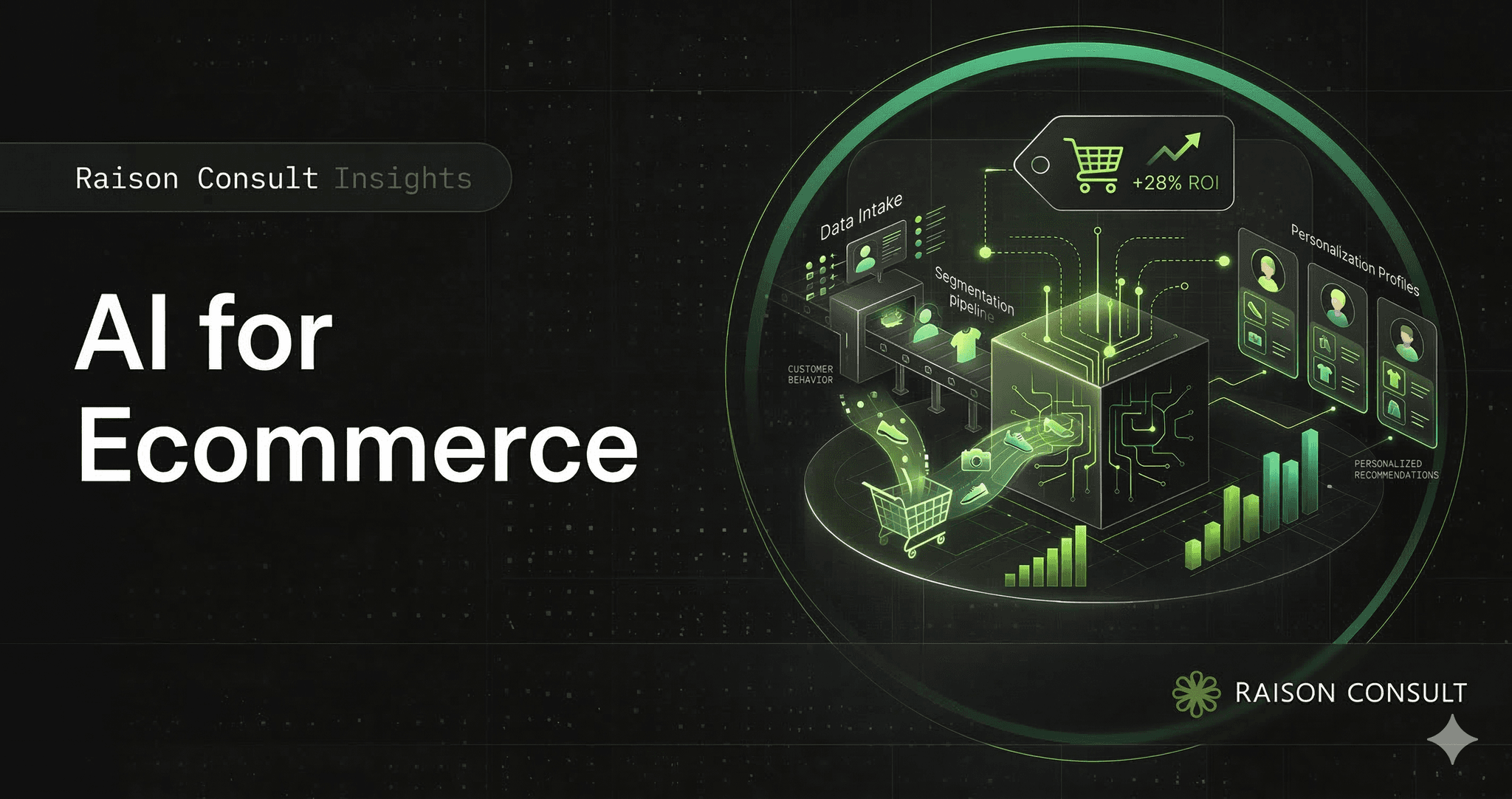
AI for e-commerce: how AI turns customer support into a revenue channel
Your customer support team costs you money. Every ticket, every "where's my order?" email, every return request: it's all expense. You hire agents, train them, lose them to turnover (the industry average is 30-45% annually), and start over.
Meanwhile, 70% of your shopping carts get abandoned. That's 7 out of 10 buyers who wanted your product enough to add it to their cart, then walked away. In the US alone, e-commerce brands lose $18 billion annually to abandoned carts.
Here's what most store owners miss: these two problems are the same problem. Your support system is reactive: it waits for customers to complain. It never reaches the customers who are about to leave. And it definitely never sells anything.
AI changes that. Not the "AI" that's just a keyword-matching chatbot with a fancy landing page. Actual AI that understands what your customer wants, catches them before they leave, and turns a support interaction into a sale.
I'm going to break down how this works, what it costs, and what kind of results to expect. All real numbers.
What "support as revenue" actually means
Traditional customer support is a cost center. You spend money to solve problems. The best possible outcome is a satisfied customer who doesn't churn (valuable, but defensive). You're spending money to not lose money.
AI-powered support flips this. Instead of just answering questions, AI does three things simultaneously:
-
Prevents cart abandonment in real time. AI detects when a shopper is about to leave (hesitation signals, cursor behavior, time on checkout page) and starts a conversation. Not a popup. A conversation that addresses the specific reason they're hesitating.
-
Recommends products during support interactions. A customer asks about sizing for a pair of shoes. AI answers the sizing question and says, "These run true to size. By the way, customers who buy these usually grab the matching belt. Want me to add it?" Product recommendations during support interactions drive 10-15% higher average order value, according to McKinsey data on AI personalization.
-
Recovers abandoned carts across channels. After someone leaves, AI follows up via email, SMS, and chat with personalized messages based on what the customer was looking at, what questions they had, and what might bring them back. This isn't a generic "you forgot something" email. It's a continuation of a conversation.
The result: support stops being a cost line and starts contributing to revenue. Shoppers who engage with AI-powered assistance are 25% more likely to convert than shoppers who don't.
The math: what AI support actually costs vs. what it recovers
I'm a numbers person. Whenever someone tells me something "transforms" a business, I ask for the math. Here's the math on AI support for e-commerce.
Cost comparison: human support vs. AI
| Metric | Human agents | AI support |
|---|---|---|
| Cost per interaction | $3-$6 | $0.25-$0.50 |
| Availability | 8-16 hours/day (with shifts) | 24/7/365 |
| Languages | 1-2 per agent | 50+ simultaneously |
| Handling capacity | 3-5 conversations at once | Unlimited concurrent |
| Turnover rate | 30-45% annually | 0% |
| Training time | 2-4 weeks per new hire | Hours to configure |
| Revenue generated | $0 (reactive only) | Active upsell + cart recovery |
That last row is the one that matters most. Human agents answer questions. AI agents answer questions and sell.
Revenue recovery example
Take a mid-market Shopify store doing $2 million per year in revenue with a 70% cart abandonment rate. That store is leaving roughly $4.7 million in potential revenue on the table. Not all of that is recoverable (some people are just browsing), but even modest recovery rates move real numbers.
| Scenario | Recovery rate | Monthly revenue recovered |
|---|---|---|
| Email-only recovery (Klaviyo/Omnisend) | 3-5% of abandoned carts | $3,900-$6,500 |
| AI real-time intervention + follow-up | 12-20% of abandoned carts | $15,600-$26,000 |
| Difference | 4x more recovery | $11,700-$19,500/mo |
The Sydney Art Store, a Shopify brand, recovered $69,000 in abandoned cart revenue in a single month using AI-powered support conversations, with 99% of support inquiries handled by AI and a 25% increase in conversion rate.
These aren't projections from a pitch deck. They're published results.
What AI handles (and what it shouldn't)
AI isn't a replacement for your entire support team. Anyone who tells you that is selling something. The winning model is a hybrid: AI handles the high-volume, repetitive work, and humans handle the judgment-heavy cases.
Here's how the ticket mix typically breaks down:
| Ticket type | % of volume | AI resolution rate | Notes |
|---|---|---|---|
| Order tracking / status | 30% | 95% | Rules-based, data-rich: AI pulls the info and responds. No human needed. |
| Product questions / FAQs | 25% | 90% | Knowledge base + product catalog grounding. AI answers from your actual product data. |
| Returns and exchanges | 20% | 85% | Well-documented policy flows. AI walks the customer through the process. |
| Cart recovery / proactive outreach | N/A | 35% recovery rate | AI reaches out before and after abandonment. Revenue impact, not ticket deflection. |
| Damaged/wrong item disputes | 15% | Low-medium | Requires evidence review and judgment calls. Human escalation. |
| Complex complaints / escalations | 10% | Low | Emotions, brand risk, edge cases. These need a person. |
Source: Resolution rates compiled from P0stman, Robylon AI, and Dextralabs case studies.
The key insight: 75% of your support volume (order tracking, product questions, and returns) can be handled by AI at a 85-95% resolution rate. That frees your human agents to focus on the complex cases that actually require human judgment. And the cart recovery work? That's entirely new revenue that didn't exist before.
NOBULL, the athletic footwear brand, hit a 50% AI resolution rate in chat and 30% across all channels using Zendesk AI. Their AI agent CSAT scores were 90-91%, and they saw a 49% year-over-year decrease in new tickets. The agents who used to handle order tracking questions now focus on high-value conversations that actually drive loyalty.
Why this is different from "just getting a chatbot"
I know what you're thinking. "We tried a chatbot. It was terrible."
You're probably right. Most chatbots deployed before 2024 were keyword-matching rule engines dressed up in a chat widget. Customer asks "where is my order?" and the bot matches "order" and spits out a generic FAQ. Customer asks "can I return this?" and the bot matches "return" and links to a policy page. Customer asks anything slightly nuanced and the bot says "Let me connect you with an agent."
That's not what we're talking about.
Modern AI support agents use large language models grounded in your specific product data, order history, and brand voice. The difference is like comparing a phone tree ("press 1 for billing, press 2 for support") to an actual conversation with someone who knows your catalog, your policies, and the customer's order history.
Here's what that looks like in practice:
Old chatbot:
Customer: "I ordered the blue jacket in medium but I'm usually between M and L in other brands. Should I exchange it?" Bot: "For our return policy, please visit example.com/returns"
AI support agent:
Customer: "I ordered the blue jacket in medium but I'm usually between M and L in other brands. Should I exchange it?" AI: "Based on your order, the Alpine Jacket runs slightly slim in the torso. Since you're between sizes, the Large would give you a more comfortable fit. I can start an exchange for the Large right now. It's in stock and I'll waive the return shipping. Want me to do that? Also, the matching Alpine Vest in Large is on sale this week if you want to add it."
That second interaction does four things: answers the question, solves the problem, keeps the sale alive, and makes a recommendation. The first interaction sends the customer to a dead-end page where they probably just give up and return the item.
How to evaluate AI support for your store
Not all AI support solutions are equal, and the market is flooded with tools that overpromise. Here's what to look for and what to avoid.
What to ask before you buy
"Can I see resolution rate data from stores like mine?" Generic claims ("we automate 60% of support!") are meaningless without context. A store selling t-shirts has a very different ticket mix than one selling electronics with warranty support. Ask for data from stores in your category and at your scale.
"How does it handle cart recovery, not just support?" Most helpdesk tools (Gorgias, Zendesk, Freshdesk) are built to manage incoming tickets. They reduce support costs, which is valuable, but they don't generate revenue. If a tool can't show you how it recovers abandoned carts and drives upsells during support conversations, it's a cost-reduction tool, not a revenue tool.
"What happens when the AI gets it wrong?" AI will get things wrong. The question is how gracefully it fails. Good AI support systems have clear escalation paths: when the AI isn't confident, it hands off to a human with full conversation context. The customer never has to repeat themselves. Bad systems loop the customer in circles or give wrong answers confidently.
"What does it integrate with?" If it doesn't connect to your Shopify data (orders, inventory, shipping), your email platform (Klaviyo, Omnisend), and your existing helpdesk, it's going to sit in a silo. Integration is where AI support lives or dies.
What the market looks like in 2026
| Tool type | Examples | What they do well | Revenue generation? |
|---|---|---|---|
| E-commerce helpdesks | Gorgias, Zendesk, Freshdesk | Ticket management, automation, multi-channel support | Limited. Some upsell features, but core model is cost reduction. |
| Cart recovery (email/SMS) | Klaviyo, Omnisend, CartStack | Post-abandonment email and SMS sequences | Recovery only. Reaches 20-30% of abandoners. No on-site prevention. |
| AI-first support | Sierra, Intercom Fin, Rep AI | Full AI resolution, learning from product data | Growing. Better at handling conversations, some upsell capability. |
| Prevention + recovery (AI) | Full-stack AI support (emerging) | On-site prevention, multi-channel recovery, revenue attribution | Yes. This is the model that turns support into revenue. |
Gorgias serves 15,000+ Shopify stores and recently launched an AI Agent that automates 30%+ of support volume. It's good for ticket management and cost reduction. But it charges per-agent (starting at $10/agent/month), a model that treats support as a cost to manage, not a revenue source.
The gap in the market is the tool that combines prevention, recovery, and attribution in one system and charges based on outcomes (revenue recovered) rather than headcount.
The five most common objections (and the data behind each)
"AI will make our support feel impersonal"
Gorgias data from 2025 shows their AI Agent scored 4.48/5 on communication and empathy, higher than the 4.27 average for human agents. AI also scored 4.77/5 on language proficiency versus 4.4 for humans. CSAT scores for AI were only 0.6 points below human averages.
The reality: bad support feels impersonal. A human agent who's burned out, undertrained, and handling their 40th "where's my order" call of the day isn't delivering warmth. AI that responds instantly with accurate, personalized information often feels more attentive than a stressed human agent.
"Our customers want to talk to a real person"
Some of them do. And they should be able to. The hybrid model doesn't eliminate human agents: it routes conversations intelligently. Simple questions go to AI. Complex or emotional situations go to humans who now have the bandwidth to actually help.
Verint's research found that 49% of consumers would accept AI support if they could switch to a human at any time. The key word is "choice," not "replacement."
"It's too expensive to implement"
AI support costs $0.25-$0.50 per interaction. Human agents cost $3-$6. Off-the-shelf AI customer service tools typically pay for themselves within 2-3 months, with average first-year ROI exceeding 500%.
Most mid-market Shopify stores can deploy AI support for $99-$499/month. If you're recovering even $5,000/month in abandoned carts, the ROI is obvious in the first month.
"We tried a chatbot and it was terrible"
I hear this a lot. But the chatbot you tried in 2022 and the AI agent available in 2026 are fundamentally different technologies. It's like comparing a 2005 flip phone camera to an iPhone 16. Same category, different universe.
If your last chatbot experience involved a keyword-matching bot that couldn't handle anything beyond "where is my order," I get the skepticism. But modern AI agents understand context, learn from your product catalog, and improve with every conversation.
"Our store is too small for AI"
If you're doing $500K+ in annual revenue and have any kind of cart abandonment (you do; everyone does), AI support will generate more revenue than it costs. The breakeven point for most tools is 50,000 interactions annually, or roughly 140 per day. If you're getting fewer interactions than that, simpler tools work fine. But most stores hitting $500K+ in revenue are well past that threshold.
How to get started (without a 6-month implementation)
I wrote about this in our article on AI consulting pricing: the biggest failure mode in AI isn't the technology, it's the implementation timeline. Companies that spend 6+ months planning deploy at half the rate of companies that plan for 2-4 weeks and start building.
Here's what a practical rollout looks like:
Week 1: Identify the biggest leak. Pull your Shopify analytics. What's your cart abandonment rate? What's your average support ticket volume? How many tickets are "where's my order?" versus actual problems? This takes an afternoon, not a strategy engagement.
Week 2-3: Deploy AI on the highest-volume, lowest-complexity tickets first. Order tracking, shipping status, product questions. These are the 75% of tickets that AI handles at 85-95% resolution rates. Your agents will feel the difference immediately.
Week 3-4: Add cart recovery. Connect AI to your checkout flow. Set up real-time intervention for hesitating shoppers and multi-channel follow-up for abandoned carts. This is where the revenue starts.
Week 4+: Optimize and expand. Monitor recovery rates, CSAT scores, and revenue attribution. Tune the AI based on real data. Add upsell and cross-sell recommendations to support interactions.
You should have a working system within a month. Not a strategy deck. Not a roadmap. A system that's running in production, answering real customer questions, and recovering real revenue.
At Raison Consult, this is what we do. We deploy AI support systems for e-commerce stores in 2-4 weeks. Our engagements include integration with Shopify, Klaviyo, and your existing helpdesk; staff training; a revenue attribution dashboard so you can see exactly what AI is recovering; and monthly optimization. We charge $5,000-$15,000/month depending on store size and complexity.
If you want to see what this would look like for your store, book a free AI assessment. It's 30 minutes. I'll look at your support ticket data and cart abandonment numbers and tell you where the money is. No pitch, no obligation; just an honest look at the numbers.
Frequently asked questions
What is AI customer support for e-commerce?
AI customer support for e-commerce uses large language models and machine learning to handle customer inquiries, recover abandoned carts, and recommend products, automatically and 24/7. Unlike traditional chatbots that follow scripted rules, modern AI support agents understand context, learn from your product catalog and order data, and handle 75-85% of support interactions without human involvement. The best implementations also generate revenue through cart recovery and upselling during support conversations.
How much does AI customer support cost for Shopify stores?
AI customer support for Shopify stores typically costs $99-$499/month for off-the-shelf tools, or $5,000-$15,000/month for fully managed implementations with custom integration and optimization. Cost per AI interaction ranges from $0.25-$0.50, compared to $3-$6 for human agents. Most stores see payback within 2-3 months through reduced support costs and recovered cart revenue. Outcome-based pricing models (where you pay a percentage of recovered revenue) are emerging but still rare.
Can AI really recover abandoned carts?
Yes. AI-powered cart recovery outperforms traditional email-only recovery by 3-4x. Email recovery campaigns (Klaviyo, Omnisend) typically convert 3-5% of abandoned carts. AI systems that combine real-time on-site intervention with multi-channel follow-up recover 12-20% of abandoned carts. The Sydney Art Store, a Shopify brand, recovered $69,000 in one month using AI-powered conversations, with a 25% conversion rate increase.
What percentage of support tickets can AI handle in e-commerce?
AI handles 75-85% of e-commerce support volume at high resolution rates: order tracking (95% resolution), product information and FAQs (90%), and returns/exchanges (85%). Complex complaints, damaged item disputes, and escalations (roughly 15-25% of tickets) still require human agents. The hybrid model (AI for routine, humans for complex) is the industry standard for 2026.
How long does it take to implement AI support for an online store?
Off-the-shelf AI support tools can be deployed in 2-4 weeks for most Shopify stores. Fully managed implementations with custom integration, staff training, and revenue attribution dashboards typically take 4-8 weeks. This is much faster than traditional helpdesk implementations because modern AI agents learn from your existing product catalog, help center content, and Shopify data without extensive manual configuration. Companies that spend over 6 months planning AI deployments have 58% lower deployment rates than those who plan for 2-4 weeks and start building.
Is AI customer support better than human support?
Neither is universally better; they're better at different things. AI excels at speed (instant response, 24/7), consistency (same quality at 3am as 3pm), scalability (unlimited concurrent conversations), and cost ($0.25-$0.50 vs. $3-$6 per interaction). Humans excel at empathy, complex problem-solving, and handling emotionally charged situations. The best e-commerce support uses both: AI handles 75-85% of volume, humans handle the rest. Gorgias data shows AI agents score higher on language proficiency and communication (4.48/5 vs. 4.27/5 for humans) while maintaining CSAT within 0.6 points of human agents.
Last updated: March 4, 2026.
Sources
Data and case studies in this article are drawn from the following sources (linked for transparency):
- Baymard Institute: Cart Abandonment Rate Statistics (2026). Average of 50 studies showing 70.22% global cart abandonment rate.
- Teneo AI: AI vs Live Agent Cost Analysis (2025). Cost per interaction comparison: AI at $0.25-$0.50 vs. human agents at $3-$6.
- Insignia Resource: Call Center Turnover Rates (2025). Contact center turnover at 30-45% annually; first-year attrition at 65-72%.
- Retainful: AI E-commerce Conversion Benchmark (2026). Shoppers engaging with AI assistance are 25% more likely to convert.
- Rep AI / Sydney Art Store Case Study. AI-powered support recovering $69,000/month in abandoned carts with 25% conversion rate increase.
- Zendesk / NOBULL Case Study. 50% AI resolution in chat, 90-91% CSAT, 49% decrease in new tickets.
- Gorgias: AI Agent Performance Data (2025). AI quality scores, empathy ratings (4.48/5 vs. 4.27/5 human), language proficiency (4.77/5 vs. 4.4/5 human).
- Cubeo AI: 25 Statistics of AI in E-commerce (2026). AI-enabled e-commerce market at $8.65B (2025), 97% of retailers increasing AI spend.
- Upsella: Cart Abandonment Statistics 2026. $18 billion in annual US revenue lost to cart abandonment.
- Digital Applied: AI Cart Abandonment Recovery Guide (2026). AI recovery rates of 12-20% vs. 3-5% for email-only.
- Forbes / MIT: Why 95% of GenAI Pilots Fail (2025). Companies spending 6+ months planning have 58% lower deployment rates.
- McKinsey: Where Is Customer Care in 2024. Contact center challenges, AI integration gaps, and rising support volumes.
Additional context from P0stman, Robylon AI, Dextralabs, Agentive AI, and VTEX/Weni case studies (cited in-text).
About the author: Joseph Musembi is the founder of Raison Consult, an AI implementation consultancy that deploys AI systems for mid-market businesses in 2-4 weeks. E-commerce, legal, and accounting/CPA verticals. Book a free AI assessment to see where AI can recover revenue for your store.
Related posts
E-commerce Revenue Leak Calculator: Find the Money Your Store Is Losing Every Month
Calculate how much revenue your e-commerce store leaks each month from cart abandonment, slow pages, poor support, and missed upsells. Includes formulas and benchmarks.
Mar 21, 2026
AI Cart Recovery vs Email Flows: What Actually Converts Better
AI cart recovery converts at 12.3% vs email's 3.3%. We break down the data, costs, and when to use each for abandoned cart recovery in e-commerce.
Mar 18, 2026