March 18, 2026· 11 min read
AI Cart Recovery vs Email Flows: What Actually Converts Better
AI cart recovery converts at 12.3% vs email's 3.3%. We break down the data, costs, and when to use each for abandoned cart recovery in e-commerce.
Joseph Musembi · Founder, Raison Consult
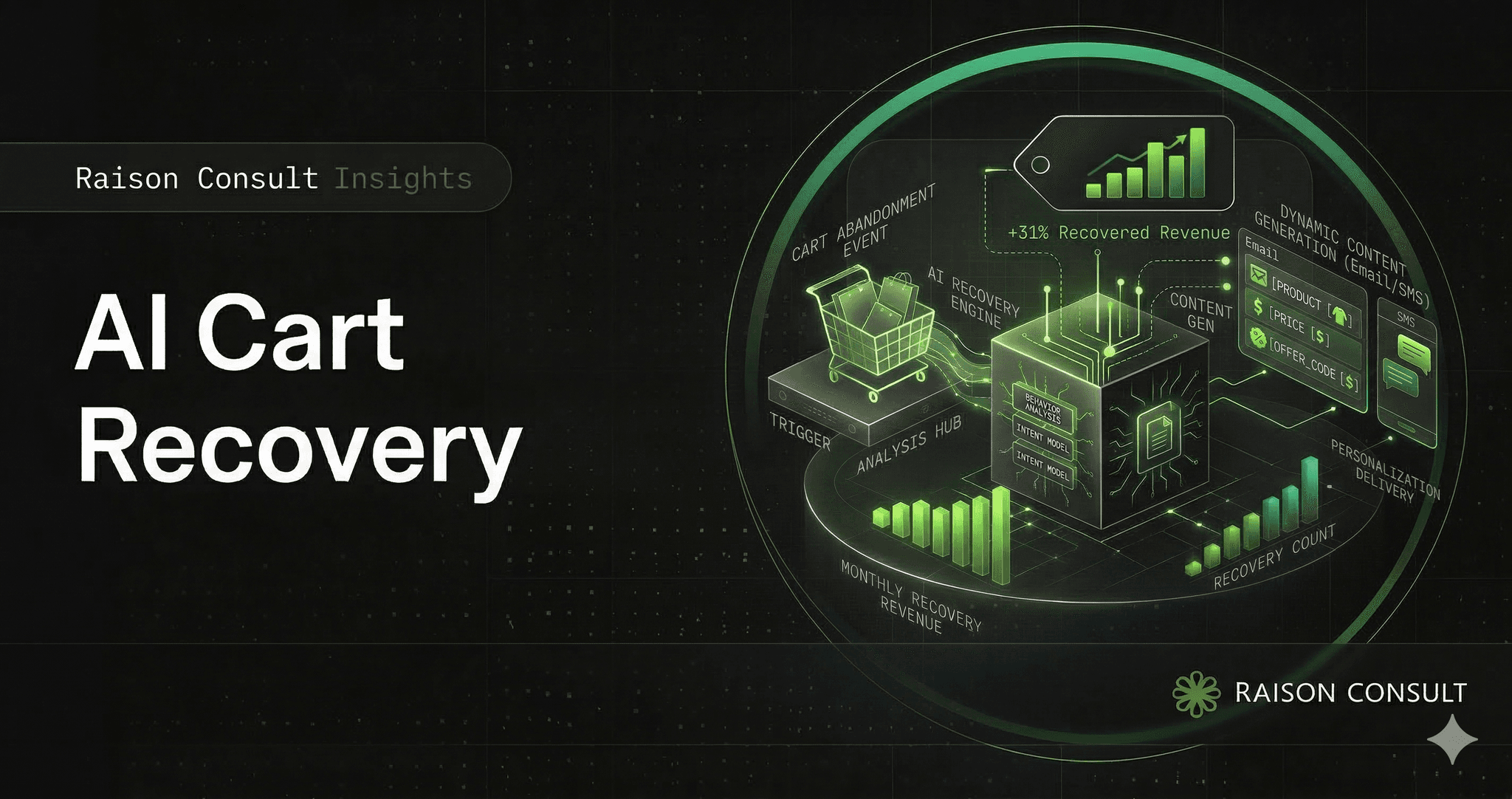
AI cart recovery vs email flows: what actually converts better
AI cart recovery converts at 12.3%. Email flows convert at 3.3%. That's the headline, and if that's all you needed, you can stop reading.
But the real story is more complicated than a single conversion rate. I've spent the last few months digging into cart recovery data across both channels, and what I found surprised me. Email isn't dead. AI isn't magic. And most e-commerce stores are leaving money on the table because they're treating this as an either/or question when the answer is both, but not the way most people implement it.
Here's the full breakdown, with actual numbers and sources you can check.
The $18 billion problem
Cart abandonment is the most expensive leak in e-commerce. Baymard Institute's analysis of 50 studies puts the average abandonment rate at 70.22% globally. That number has barely moved since 2006, despite two decades of checkout improvements. Seven out of ten people who add something to their cart never buy it.
On mobile it's worse: 85.2% abandonment. And mobile is where 60-65% of your traffic comes from.
In the US alone, that translates to roughly $18 billion in annual lost revenue. The number globally is closer to $260 billion in recoverable revenue across the US and EU, according to Digital Applied's 2026 analysis.
The question isn't whether you should try to recover abandoned carts. The question is how.
What email flows actually deliver
Let's start with what works. Email cart recovery flows are the most established tool in e-commerce. Klaviyo's benchmark data shows abandoned cart emails are the single highest-converting automated flow, generating 30x more revenue per recipient than one-time campaign sends.
Here's what the numbers look like:
| Metric | Average | Top 10% |
|---|---|---|
| Open rate | 50.5% | 65.3% |
| Placed order rate (conversion) | 3.33% | Not disclosed |
| Revenue per recipient | $3.65 | $28.89 |
Those aren't bad numbers. A 3.33% conversion rate on people who already showed purchase intent is reasonable. And the top 10% of Klaviyo users are pulling $28.89 per recipient, which is genuinely impressive.
Multi-email sequences outperform single sends by a wide margin. Klaviyo's own analysis found three-email sequences generated $24.9 million versus $3.8 million for single emails. The standard cadence that works: first email at 30-60 minutes, second at 24 hours, third at 72 hours.
Omnisend's 2024 report adds a useful data point: one in every two people who click a cart abandonment email makes a purchase. That's a 50% click-to-purchase rate, compared to one in twenty for regular campaign emails.
So email works. But there's a ceiling, and most stores are already at it.
Where email flows break down
Here's the problem nobody in the Klaviyo ecosystem wants to talk about: a 3.33% conversion rate means 96.7% of your abandoned carts go unrecovered through email. Even the best email programs in the world leave the vast majority of revenue on the table.
Three structural problems limit email recovery:
1. Timing. The first email lands 30-60 minutes after abandonment. By then, the customer has closed the tab, opened Instagram, and mentally moved on. Research from SilverWebBuzz shows purchase intent peaks in a 5-10 minute window while the customer is still on-site. Email misses this window entirely.
2. The discount trap. Most cart recovery emails include a discount code. ActiveCampaign's research reveals the ugly side of this: customers now deliberately abandon carts to trigger the discount email they know is coming. Nebulab's analysis found that 40% of "recovered" customers would have purchased at full price. That's pure margin you're giving away.
Consider the math. A product with a $100 price and $55 cost gives you $45 gross profit at full price. At 30% off, you're down to $15 gross profit per unit. You'd need to sell three times the volume just to maintain the same profit dollars. And you've trained that customer to wait for a discount next time.
3. Only 26% of abandonment is price-related. This one keeps coming back to me. Growth Suite's research shows that the primary reasons people abandon carts are unexpected costs (48%), comparison shopping (26%), complicated checkout (22%), and payment concerns (18%). A 10% off coupon doesn't fix a confusing checkout flow. It doesn't fix a surprise $12 shipping charge at the last step. It just masks the real problem with a bribe.
What AI cart recovery does differently
AI cart recovery isn't just email with better subject lines. It's a fundamentally different approach: intervening in real time, while the customer is still on your site, before they abandon.
Here's the difference in how each system works:
| Factor | Email flows | AI cart recovery |
|---|---|---|
| When it activates | 30-60 min after abandonment | 2-4 seconds before abandonment (predictive) |
| Where it engages | Customer's inbox | On-site, in the buying moment |
| What it does | Reminds + offers discount | Identifies friction + resolves it |
| Channels used | Email (maybe SMS) | Chat, SMS, WhatsApp, email |
| Response to objections | Static template | Dynamic conversation |
| Conversion rate | 3.33% average | 12.3% (proactive AI) |
Sources: Klaviyo benchmarks, AgentiveAIQ analysis, Digital Applied.
The conversion difference is stark. AgentiveAIQ's data shows proactive AI chatbots convert at 12.3%, compared to 3.1% for passive bots and 3.33% for email. That's a 4x difference.
And it's not just about conversion rate. AI systems analyze 50+ behavioral signals to predict abandonment 2-4 seconds before it happens, according to Digital Applied's research. A customer who hesitates on the shipping page gets a different intervention than one who stalls at payment. The AI can answer questions, offer free shipping if the cart value justifies it, or surface reviews for the specific product they're considering. All in real time, while their credit card is still in their hand.
The channel comparison nobody shows you
Email isn't the only recovery channel anymore. Here's how all the channels stack up, based on data from Revenue Boost and Dialzara's analysis:
| Channel | Open rate | Conversion rate | Cost per message | Best for |
|---|---|---|---|---|
| On-site AI chat | N/A (already on-site) | 12.3% | $200-$500/mo platform fee | Real-time objection handling |
| 95-98% | 10-20% | $0.05-$0.08 | Mobile-first markets | |
| SMS | 90-98% | 5-10% | $0.01-$0.03 | Time-sensitive recovery |
| Push notifications | 50-60% | 3-5% | Free (with app) | First touchpoint |
| 15-25% (50% for cart flows) | 3.33% | $0.001-$0.01 | Low cost, high volume |
Sources: Revenue Boost, Klaviyo benchmarks, AgentiveAIQ.
The data tells a clear story. Email has the lowest cost per message but also the lowest engagement. WhatsApp and SMS crush email on open rates and conversion but cost more per touchpoint. On-site AI chat has the highest conversion rate because it catches people before they leave.
What's interesting is the multi-channel result: stores using SMS, email, and messaging together recover 35%+ of abandoned carts, versus 5-10% with email alone. That's according to Revenue Boost's Shopify data.
When email flows still win
I'm not here to trash email. It's still the right choice in specific situations:
Low AOV stores ($15-$40 products). If your average order value is $25, the math doesn't work for an AI platform at $300-$500/month. Klaviyo's free tier handles 250 contacts and 500 emails/month. At low AOV, email's lower conversion rate is offset by its near-zero marginal cost.
Simple products with no consideration. If you sell candles or phone cases, there's not much for AI to discuss. The customer either wants it at that price or they don't. A reminder email with a product image is usually enough.
Stores under 500 monthly visitors. You need traffic volume for AI cart recovery to justify its cost. With 500 visitors and a 70% abandonment rate, you're looking at 350 abandoned carts. At email's 3.33% conversion rate, that's about 12 recovered orders. At AI's 12.3%, it's about 43. Whether the delta of 31 orders justifies $300-$500/month depends on your AOV.
Stores with mature, optimized email flows. If you're already in the top 10% of Klaviyo users pulling $28.89 revenue per recipient, there's less to gain. Your email program is working. Add AI on top of it, don't replace it.
When AI cart recovery wins
AI wins when the problem isn't awareness (the customer forgot about the cart) but friction (something stopped them from buying). That's most of the time.
High AOV products ($100+). When someone abandons a $300 cart, there's usually a specific reason: shipping cost surprise, payment concern, product question, or comparison shopping. AI can have that conversation. Email can only offer a discount. Quickchat AI's data shows AI-powered recovery can boost AOV by 10-15% through intelligent cross-selling during the conversation.
Stores with complex products. Supplements, electronics, custom goods, anything where customers have questions before buying. AI can answer "Does this work with my current setup?" in real time. Email can't.
Mobile-heavy traffic. Your mobile abandonment rate is 85.2%. Those customers aren't going back to check email on their phone. But they'll respond to an on-site chat popup, an SMS, or a WhatsApp message. Revenue Boost's Shopify data shows WhatsApp achieves 95-98% open rates and 10-20% conversion rates on mobile.
Stores leaking margin through discounts. If your current email flows rely on 10-15% discount codes, you're likely giving away margin on 40% of sales that would have happened at full price. AI addresses the actual objection instead of defaulting to "here's 10% off."
The real answer: how to combine them
The stores recovering the most revenue aren't choosing between AI and email. They're sequencing them.
Here's the approach that works, based on the multi-channel data:
Step 1: On-site AI intervention (0-5 minutes). When behavioral signals indicate a customer is about to abandon, the AI engages. Not a generic popup. A contextual message: "Looks like shipping cost is a concern. Did you know orders over $75 ship free? You're $12 away." This catches the highest-intent abandoners while they're still ready to buy.
Step 2: SMS or WhatsApp (1-4 hours). For customers who do leave, a short text message with a direct cart link. No discount yet. Just: "You left some items in your cart. Here's your link to finish checking out." SMS converts at 5-10%, and the 90%+ open rate means people actually see it.
Step 3: Email flow (24-72 hours). The standard three-email sequence kicks in for anyone who hasn't converted through faster channels. First email is a reminder with product images. Second email adds social proof (reviews, ratings). Third email, and only the third, includes a discount if you choose to offer one.
This sequence works because each channel targets a different window of intent. On-site AI catches people in the buying moment. SMS catches them while the intent is warm. Email catches the long tail.
What this costs
Here's a rough cost comparison for a store doing 5,000 monthly visitors:
| Approach | Monthly cost | Expected recovery rate | Recovered revenue (assumes $80 AOV, 3,500 abandoned carts) |
|---|---|---|---|
| Email only (Klaviyo) | $35-$75/mo | 3-5% | $8,400-$14,000 |
| AI chat only | $200-$500/mo | 10-15% | $28,000-$42,000 |
| Multi-channel (AI + SMS + email) | $400-$800/mo | 20-35% | $56,000-$98,000 |
These are illustrative estimates based on industry benchmarks, not guarantees. Your actual results depend on your product, traffic quality, and checkout experience. But the order of magnitude difference is consistent across the data from Closer Apps, AgentiveAIQ, and Revenue Boost.
The ROI math is simple. If multi-channel recovery costs $800/month and generates even $30,000 in additional recovered revenue compared to email-only, you're looking at a 37x return. Even if the actual numbers are half what the benchmarks suggest, it's a clear winner.
What most stores get wrong
I talk to e-commerce operators every week, and the same mistakes keep coming up:
Leading with discounts. If your first recovery touchpoint is a 15% off coupon, you're training customers to abandon. ActiveCampaign's research confirms what most operators suspect: customers deliberately abandon to trigger the discount they know is coming. Start with a reminder. Address the friction. Offer a discount only as the last resort, not the first move.
Ignoring mobile. Your mobile abandonment rate is 85.2%, and email is the worst channel for reaching mobile users. If you're not using SMS or WhatsApp for mobile cart recovery, you're ignoring the majority of your abandoned carts.
Treating all abandoners the same. Someone who spent 10 minutes browsing, added three items, and got to the payment page is a very different abandoner than someone who added one item and left within 30 seconds. AI can differentiate between these. A static email flow can't.
Not fixing the checkout first. Baymard Institute data shows that 48% of abandonment is caused by unexpected costs at checkout. If you surprise customers with shipping fees at the last step, no recovery tool, AI or email, will fully fix the problem. Show shipping costs early. Reduce checkout fields. Offer guest checkout. Do the basics first.
The bottom line
AI cart recovery converts at 12.3%. Email flows convert at 3.33%. Multi-channel approaches combining AI, SMS, and email recover 35%+ of abandoned carts compared to 5-10% for email alone.
But the numbers only tell part of the story. The real difference is in the approach. Email flows react to abandonment after the fact. AI systems prevent it in real time. Email offers discounts to lure people back. AI identifies what stopped them and fixes it.
For most e-commerce stores doing over $500K in annual revenue, the move is clear: keep your email flows running (they're cheap and they work at the margins), add AI for real-time on-site intervention, and layer in SMS or WhatsApp for the 1-4 hour window. That combination, based on the data, recovers 3-7x more revenue than email alone.
If you're running a Shopify store and want to know exactly how much revenue you're losing to abandoned carts, and what a multi-channel recovery system would look like for your specific business, book a free AI assessment. We'll run the numbers with your actual traffic and AOV.
Frequently asked questions
What is AI cart recovery?
AI cart recovery uses artificial intelligence to detect when a customer is about to abandon their shopping cart and intervenes in real time. Unlike email flows that send reminders after the customer has left, AI systems engage while the customer is still on-site, typically through chat, to address specific objections like shipping costs, product questions, or payment concerns. Proactive AI cart recovery converts at 12.3% compared to 3.33% for traditional email flows, according to AgentiveAIQ's analysis.
How much do abandoned cart emails recover?
The average abandoned cart email flow converts at 3.33% with $3.65 revenue per recipient, according to Klaviyo's benchmark data. Top-performing brands achieve $28.89 revenue per recipient. Multi-email sequences (3 emails over 72 hours) significantly outperform single emails, generating roughly 6.5x more revenue. However, email still leaves 96-97% of abandoned carts unrecovered.
Is AI cart recovery better than Klaviyo?
They solve different problems. Klaviyo email flows are the best tool for post-abandonment recovery at low cost ($35-$75/month for most stores). AI cart recovery handles real-time, on-site intervention at higher cost ($200-$500/month) but higher conversion rates (12.3% vs 3.33%). The best approach is to use both: AI for real-time on-site recovery, and Klaviyo for the follow-up email sequence 24-72 hours later.
What is a good abandoned cart recovery rate?
The average Shopify store recovers 8-15% of abandoned carts, with an industry average of about 10.7%, according to Closer Apps' 2025 benchmarks. Stores using multi-channel recovery (AI + SMS + email) report 35%+ recovery rates. Luxury goods stores tend to recover at the high end (14-18%) while electronics stores are lower (6-9%).
Should I offer a discount in abandoned cart emails?
Not as your first touchpoint. Research from Growth Suite shows only 26% of cart abandonment is actually price-related. Leading with discounts trains customers to abandon deliberately and erodes margins. A better approach: send a reminder first, address friction points second, and only offer a discount in the third email for customers who haven't converted through other means. Nebulab's data found 40% of "recovered" customers would have purchased at full price anyway.
How fast should I send an abandoned cart email?
The first email should go out within 30-60 minutes of abandonment. Omnisend's data supports a three-touch cadence: first email at 30-60 minutes, second at 24 hours, and third at 72 hours. However, if you're using AI on-site recovery and SMS, your email becomes the third touchpoint rather than the first, which actually improves its effectiveness because the easiest recoveries are already handled by faster channels.
Last updated: March 4, 2026. We update this guide quarterly.
Sources
Cart abandonment rates, conversion benchmarks, and channel performance data in this article are drawn from the following reports and publications:
- Baymard Institute: Cart Abandonment Rate Statistics (2026). Meta-analysis of 50 studies showing 70.22% average cart abandonment rate.
- Baymard Institute: Checkout Usability Report. Primary abandonment reasons: unexpected costs (48%), account creation (26%), complex checkout (22%).
- Klaviyo: Abandoned Cart Benchmark Report. Email flow conversion rates (3.33%), revenue per recipient ($3.65 average, $28.89 top 10%), and multi-email sequence performance.
- Omnisend: Cart Abandonment Email Best Practices (2024). Click-to-purchase rates and email sequence timing.
- AgentiveAIQ: AI Cart Recovery ROI Data. AI recovery rates (45-56%) and proactive vs passive chatbot conversion comparison (12.3% vs 3.1%).
- AgentiveAIQ: Best AI for E-Commerce Cart Recovery (2025). Agentic AI conversion rates and technology comparison.
- Digital Applied: AI Cart Abandonment Recovery Guide (2026). Behavioral signal analysis, predictive abandonment detection, and $260 billion recoverable revenue figure.
- Revenue Boost: Multi-Channel Cart Recovery for Shopify (2026). Channel-by-channel open rate and conversion rate comparison; multi-channel vs single-channel recovery rates.
- Closer Apps: Shopify Abandoned Cart Recovery Benchmarks (2025). Average Shopify recovery rate (10.7%) and industry-specific benchmarks.
- Quickchat AI: Chatbot Cart Abandonment Strategy. AI-powered AOV increases (10-15%) and proactive recovery strategies.
- Dialzara: AI SMS vs Email for Cart Recovery. SMS + email combined recovery improvement (35% more than either alone).
- ActiveCampaign: Abandoned Cart Coupons. Discount conditioning and customer behavior training effects.
- Nebulab: Smarter E-Commerce Discounting. Margin erosion data: 40% of recovered customers would have purchased at full price.
- Growth Suite: Cart vs Browse Abandonment Recovery. Price-related abandonment at 26%; cannibalization tracking methodology.
- Upsella: Cart Abandonment Statistics 2026. Device-specific abandonment rates: mobile 85.2%, tablet 70.3%, desktop 66.7%.
- SilverWebBuzz: Real-Time AI Intervention. 5-10 minute purchase intent window and real-time intervention advantage.
About the author: Joseph Musembi is the founder of Raison Consult, an AI implementation consultancy that deploys AI for mid-market e-commerce, legal, and professional services companies in 4-8 weeks. Book a free AI assessment to see what AI cart recovery could recover for your store.
Related posts
E-commerce Revenue Leak Calculator: Find the Money Your Store Is Losing Every Month
Calculate how much revenue your e-commerce store leaks each month from cart abandonment, slow pages, poor support, and missed upsells. Includes formulas and benchmarks.
Mar 21, 2026
AI for E-commerce: How AI Turns Customer Support Into a Revenue Channel
Your e-commerce helpdesk costs you money. AI support recovers abandoned carts, drives upsells, and cuts costs by 85%. Real numbers, real case studies, no fluff.
Mar 7, 2026